- Blog
- July 24, 2026
Microsoft Fabric Lakehouse Reference Architecture for Modern Analytics

- Blog
- July 24, 2026
Microsoft Fabric Lakehouse Reference Architecture for Modern Analytics
Modern analytics depends on fast, reliable access to trusted data. Yet many organizations continue to work with fragmented platforms that create data silos, inconsistent reporting, and complex governance challenges. A well-designed Microsoft Fabric lakehouse reference architecture provides a unified foundation that simplifies analytics, strengthens governance, and supports enterprise-scale reporting, self-service BI, and AI initiatives.
Understanding the Microsoft Fabric Lakehouse
A Microsoft Fabric lakehouse combines the flexibility of a data lake with the structure of a data warehouse within a unified analytics platform. Instead of maintaining multiple storage environments, organizations can centralize their data while supporting engineering, business intelligence, and advanced analytics from the same ecosystem.
At the core is OneLake, supported by Lakehouses, SQL Analytics Endpoints, pipelines, notebooks, and semantic models. Together, these services create a streamlined architecture that reduces data duplication and enables faster access to trusted business data.
Building the Reference Architecture
A successful reference architecture follows the medallion design pattern, where data progresses through clearly defined layers before reaching business users.
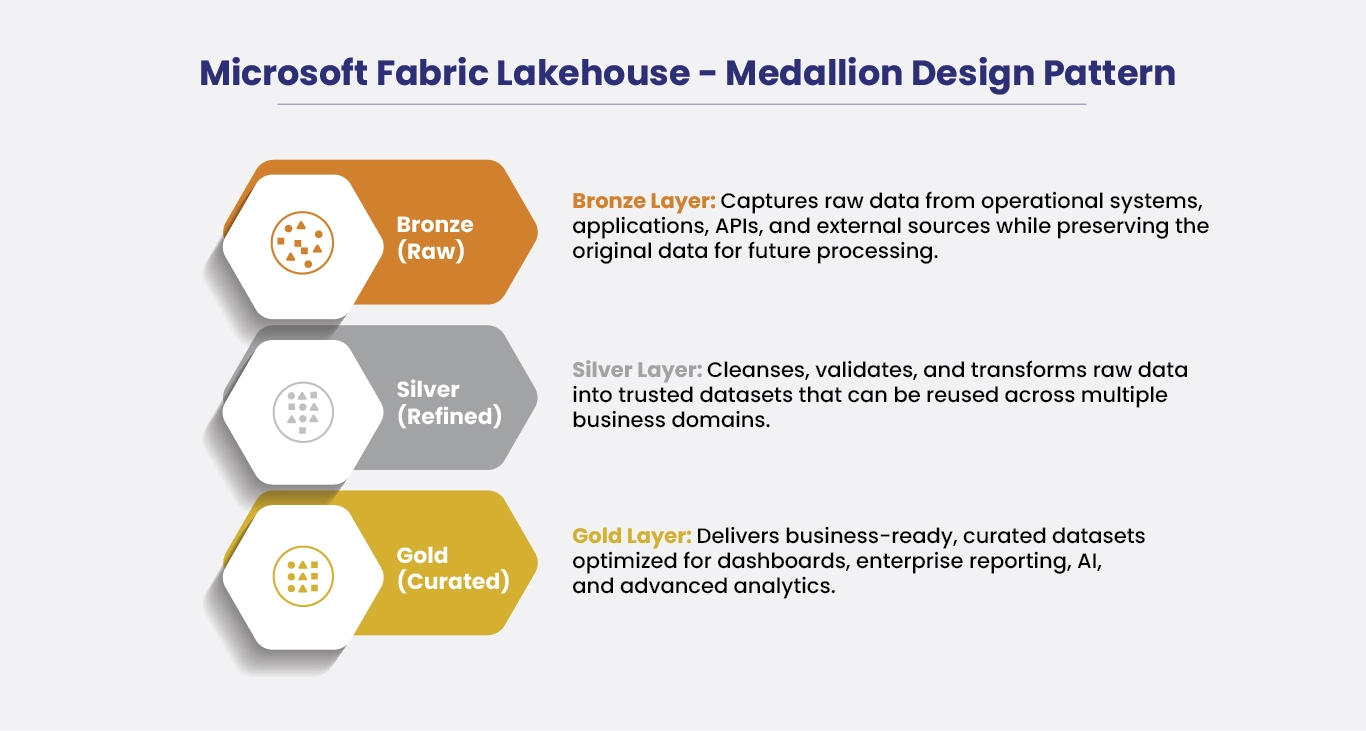
- Bronze Layer: Captures raw data from operational systems, applications, APIs, and external sources while preserving the original data for future processing.
- Silver Layer: Cleanses, validates, and transforms raw data into trusted datasets that can be reused across multiple business domains.
- Gold Layer: Delivers business-ready, curated datasets optimized for dashboards, enterprise reporting, AI, and advanced analytics.
This layered architecture improves data quality, simplifies governance, and creates a consistent foundation for enterprise analytics.
Designing Reliable Data Pipelines
A strong lakehouse architecture depends on efficient data movement rather than simply collecting more data. Microsoft Fabric supports multiple ingestion patterns, including batch processing, real-time streaming, shortcuts, and automated pipelines, allowing organizations to integrate information from diverse enterprise systems.
Standardized ingestion and transformation workflows help reduce unnecessary data duplication while ensuring consistent data quality across the analytics platform. As business requirements evolve, these pipelines can scale without any major architectural changes.
Governance by Design
Governance should be embedded into the architecture from the beginning rather than added after deployment. Clearly defined workspace structures, role-based access control, data ownership, sensitivity labels, and lineage help organizations maintain security and consistency across analytics environments.
By integrating governance into everyday operations, enterprises can confidently scale Microsoft Fabric while supporting compliance, collaboration, and trusted decision-making.
Designing for Scale and Performance
A scalable architecture separates ingestion, transformation, and consumption so that each workload can operate efficiently without affecting others. Optimized data structures, curated serving layers, and capacity planning help maintain consistent performance as data volumes continue to grow.
Designing for scalability from the start allows organizations to support enterprise reporting, self-service analytics, and AI workloads on a common platform without repeated architectural redesign.
Where This Architecture Delivers the Most Value
A Microsoft Fabric lakehouse reference architecture supports a wide range of modern analytics initiatives, including:
- Enterprise reporting with a centralized and trusted data foundation.
- Self-service BI using governed datasets that reduce duplicate reporting.
- Data modernization by replacing fragmented legacy analytics platforms.
- AI and advanced analytics through high-quality, business-ready data.
- Hybrid analytics environments that combine lakehouse and warehouse workloads where appropriate.
Design Principles for Long-Term Success
Successful implementations are driven by sound architectural decisions rather than technology alone. Organizations should:
- Design a clear Bronze – Silver – Gold data flow.
- Establish ownership for data quality and governance early.
- Build reusable data assets instead of project-specific datasets.
- Scale the platform incrementally as new workloads are introduced.
Following these principles helps organizations maintain a flexible, governed, and future-ready analytics environment.
Conclusion
A Microsoft Fabric lakehouse reference architecture provides a practical blueprint for modern enterprise analytics. By combining unified storage, reliable data pipelines, layered data management, and built-in governance, organizations can simplify analytics while improving scalability and operational efficiency.
With expertise in Microsoft Fabric, data engineering, and enterprise analytics, MSRcosmos helps organizations design and implement scalable lakehouse architectures that accelerate business value and prepare data platforms for future AI-driven innovation.