- Blog
- July 28, 2026
GenAI Security Beyond Prompt Injection

- Blog
- July 28, 2026
GenAI Security Beyond Prompt Injection
Organizations are rapidly adopting Generative AI to improve customer experiences, automate workflows, and enhance employee productivity. While prompt injection has become the most discussed AI security risk, it represents only one part of a much larger challenge. Enterprise GenAI applications rely on data sources, retrieval systems, external tools, APIs, and autonomous workflows that significantly expand the attack surface.
To scale AI confidently, organizations need to secure the entire GenAI ecosystem. This means protecting data, controlling identity and access, monitoring AI activity, validating system behavior, and preparing for security incidents before they occur.
Expanding the GenAI Threat Model
Prompt injection deserves attention because it can manipulate model behavior, but modern GenAI applications involve far more than prompts. Retrieval-Augmented Generation (RAG), enterprise knowledge bases, APIs, plugins, and AI agents introduce additional attack paths that traditional security controls may not fully address.
Attackers often do not need to compromise the model itself. Exploiting weak permissions, exposed connectors, unsecured APIs, or poorly governed data sources can be enough to access sensitive information or trigger unintended actions. Securing enterprise AI therefore requires protecting the complete application architecture rather than focusing solely on model behavior.
Securing Enterprise Data Flows
Enterprise GenAI systems continuously move data between users, models, knowledge repositories, and business applications. Every interaction creates an opportunity for sensitive information to be exposed if proper controls are not in place.
Common risks include overly permissive access to knowledge bases, poisoned documents within retrieval pipelines, unsecured plugin responses, conversation history containing confidential information, and external integrations that return unverified data. These issues are often architectural rather than model-specific.
Organizations should implement data classification, access policies, encryption, and validation throughout the entire data lifecycle. Treating data security as a platform capability rather than an AI feature significantly reduces the risk of unintended data exposure.
Identity, Access, and Observability
Enterprise GenAI applications should follow the same identity and access principles used for other business-critical systems. Users, AI agents, service accounts, and integrated applications should receive only the permissions required to perform their intended tasks.
Visibility is equally important. Organizations should capture prompt activity, retrieval events, tool execution, model responses, and user interactions to create a complete audit trail. Strong observability enables security teams to detect abnormal behavior, investigate incidents, and demonstrate compliance while continuously improving AI governance.
Testing AI Resilience Through Red Teaming
Security testing should extend beyond traditional application testing. AI red-teaming evaluates how GenAI systems respond to realistic attack scenarios such as prompt injection, jailbreak attempts, malicious documents, unauthorized tool execution, and data exfiltration.
Effective programs combine manual testing with automated evaluations to uncover vulnerabilities before production deployment. Regular red-teaming also helps organizations validate security controls as AI applications evolve and new capabilities are introduced.
Preparing for AI Security Incidents
Despite strong preventive controls, security incidents can still occur. Organizations should establish AI-specific incident response procedures that address data exposure, compromised integrations, malicious outputs, and unauthorized AI actions.
A practical response plan includes detecting abnormal behavior, isolating affected systems, reviewing AI activity logs, revoking compromised credentials, notifying stakeholders, and restoring trusted operations. Preparing these playbooks in advance enables faster recovery while minimizing business disruption.
A Security Framework for Enterprise GenAI
Building secure GenAI applications requires an operating model that integrates security throughout the AI lifecycle.
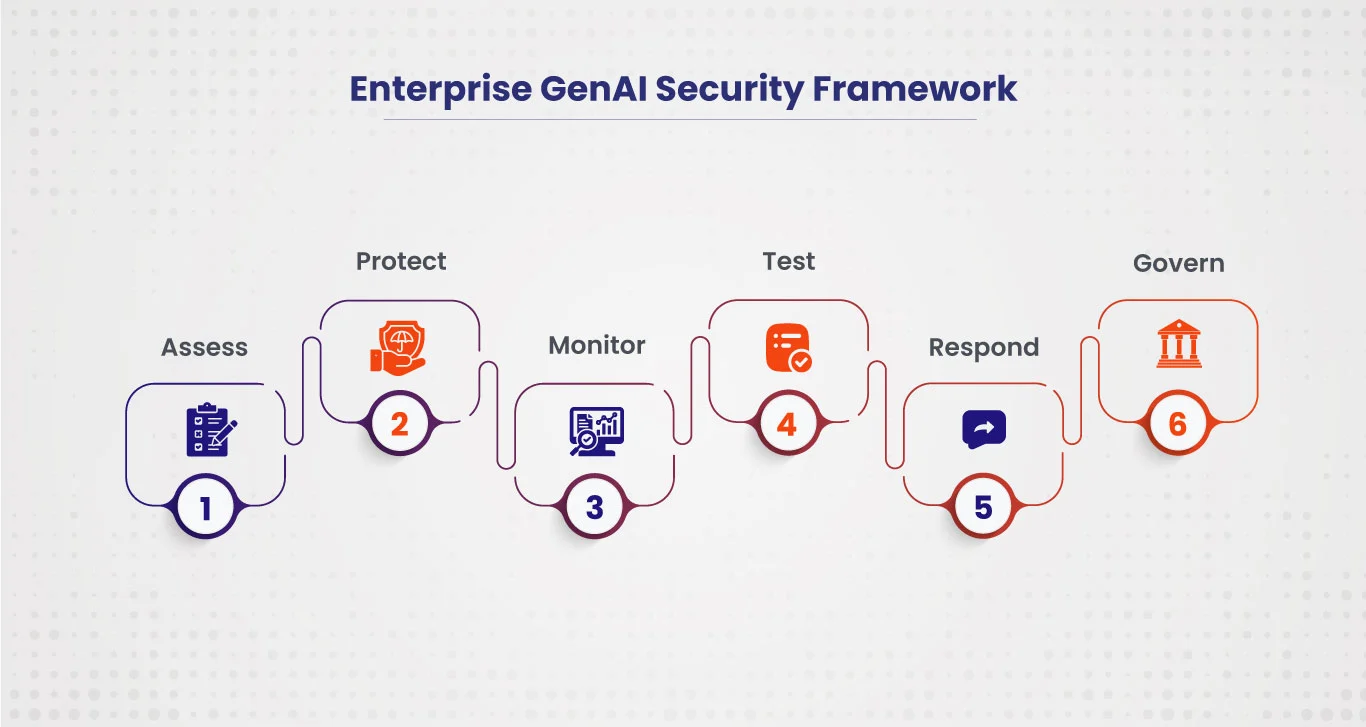
- Assess: Identify business risks, sensitive data, and regulatory requirements before deployment.
- Protect: Enforce least-privilege access, secure connectors, encrypt sensitive information, and validate data sources.
- Monitor: Capture prompts, retrieval events, tool executions, and model responses for continuous visibility.
- Test: Perform regular AI red-teaming and adversarial testing to validate security controls.
- Respond: Establish incident response playbooks tailored to AI-specific threats.
- Govern: Define ownership, policies, compliance standards, and continuous risk management across AI initiatives.
Conclusion
Enterprise GenAI security extends far beyond defending against prompt injection. As AI applications become more connected to enterprise data and business processes, organizations must secure the complete ecosystem, including data flows, identities, integrations, monitoring, and operational processes.
Organizations that adopt a security-first operating model can accelerate AI adoption while reducing risk and maintaining regulatory compliance. With expertise in AI, cloud, data platforms, and enterprise security, MSRcosmos helps organizations build scalable, secure, and governed GenAI solutions that support long-term innovation.