- Blog
- November 12, 2026
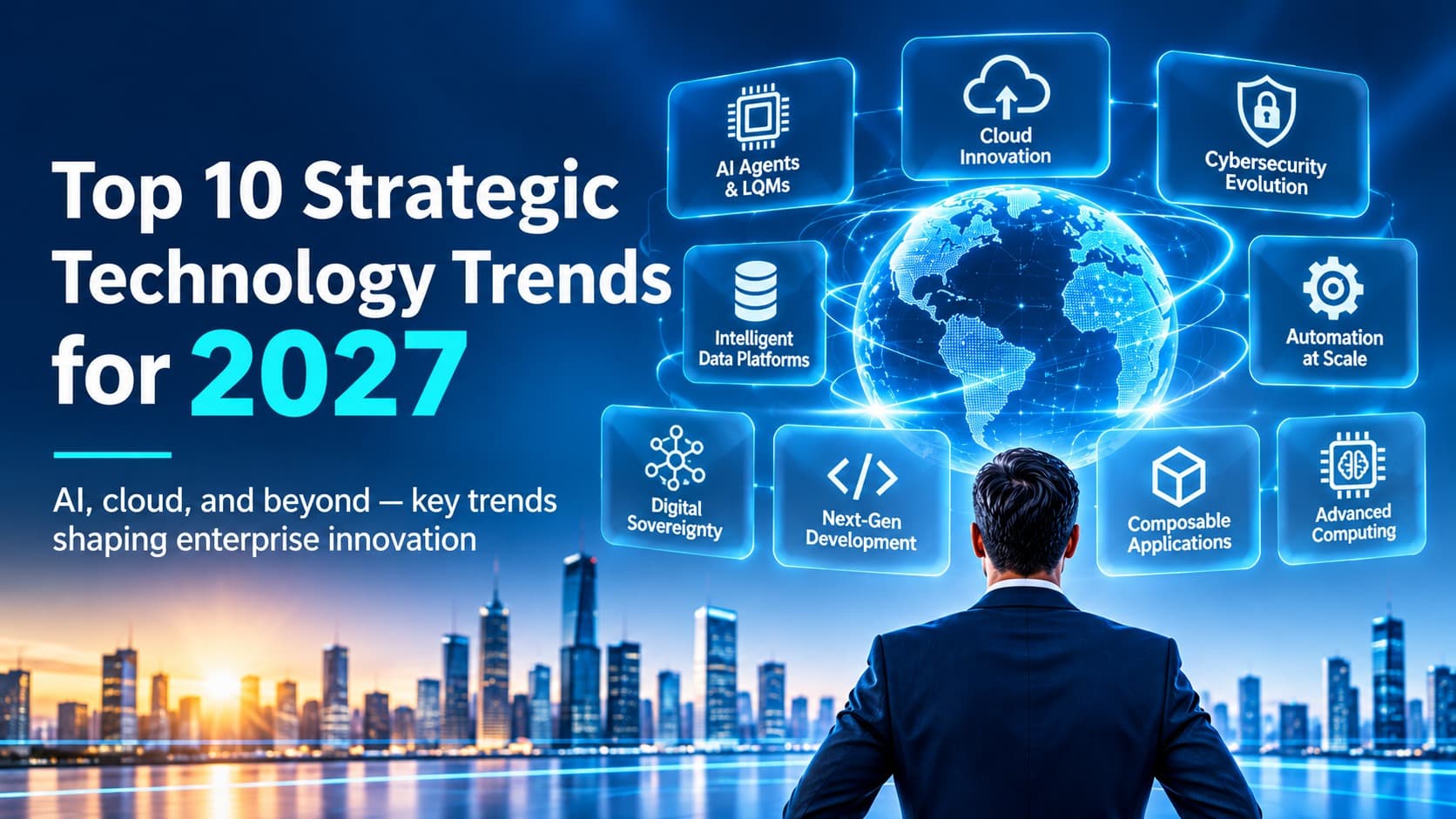
Top 10 Strategic Technology Trends for 2027
- Blog
- November 12, 2026
Top 10 Strategic Technology Trends for 2027
Introduction: Which Technology Trends Will Impact Enterprise IT In 2027?
Enterprise IT is more than just adopting standard cloud and dabbling with AI. Increasingly, enterprises are looking at autonomous artificial intelligence technologies, new data architectures, intelligent automation, and increased digital governance.
Gartner’s October 2026 report on major technology trends for 2027 identified eleven changes that will affect company IT strategies. These include advances in AI thinking, software engineering, cybersecurity, digital sovereignty, and novel computing architectures.
These advancements offer potential for organizations that operate SAP S/4HANA, Oracle, Microsoft Azure, AWS, and enterprise data platforms to modernize infrastructure, increase operational efficiency, and better the governance of technology.
Here are 10 key tech trends corporate IT leaders should monitor in 2027.
1. Large Quantitative Models (LQM)
Large-scale quantitative models. Building artificial intelligence systems that can analyze numerical inputs, recognize intricate patterns, and enable quantitative thinking.
Traditional LLMs are predominantly language-focused, while LQMs are built to handle numerical and analytical tasks.
Business Apps:
- Financial risk analysis and prediction.
- Optimization of supply chain
- Production and demand forecasting.
- Production Planning.
Businesses can employ quantitative models, ERP data, historical transactions, and analytics platforms to improve their business forecasts.
Implementation considerations include developing robust data pipelines, validating model outputs, and integrating quantitative models with controlled enterprise analytics systems.
2. Speech Inference Model
Speech reasoning models go beyond traditional voice AI. They help systems understand what people say and the context, and then provide a proper response.
Enterprise applications:
- Smart Customer Service.
- Voice-enabled IT service desks.
- Employee Assistance Programs.
- Automated customer conversations
Organizations can then integrate these features with CRM systems, enterprise APIs, and workflow platforms.
Implementation consideration Voice data privacy, authentication, conversational correctness, and human escalation procedures should be prioritized.
3. Physical AI and World Models.
Artificial intelligence uses world models to examine situations, to simulate occurrences, and to predict their implications in the future. When paired with sensors and simulation technologies, they enable intelligent operation in physical settings with robots.
Enterprise applications:
- Smart manufacturing.
- Warehouse automation.
- Industrial robots.
- Predictive maintainance.
Implementation consideration: Do not deploy autonomous systems without integrating IoT sensors, edge computing, simulation platforms, and operational safety measures.
4. AI Context Platform
AI Context Platforms provide AI agents with relevant enterprise information, business relationships, permissions, and operational context. The lack of reliable context means that artificial intelligence systems can produce responses that are technically plausible but do not meet the expectations of the company.
Enterprise applications:
- Enterprise Knowledge Assistants
- Data analytics for SAP and ERP.
- Intelligent Reporting.
- Context-aware workflow automation
You can enable enterprise AI utilizing governed data foundations with platforms like Microsoft Fabric and Databricks.
Implementation considerations are data catalogs, semantic models, retrieval augmented generation (RAG), metadata management, and role-based limitation of access.
5. Utilize AI Code Agent
AI coding agent harness offers control ways to govern autonomous AI coding agents during the software development lifecycle.
These frameworks coordinate code production, testing, debugging, tool access and validation.
Enterprise applications:
- Computer-aided software engineering
- Debug and test code.
- Modernizing legacy apps.
- Technical documentation.
Implementation consideration: Integrate coding agents with Git repositories, CI/CD pipelines, automated testing, and DevSecOps. Major production changes should require human approval.
6. AI agent identity and access management
When AI agents are interacting with corporate software, companies will need identity and access management policies that are situational. We need to be able to identify AI agents, define their permissions, and audit their conduct.
Enterprise applications:
- Automation of ERP workflow.
- IT management.
- Robotic process automation.
- Multi-agent enterprise processes.
Implementation considerations: Implement least privilege access, role-based permissions, short-lived credentials, and constant monitoring. Microsoft Entra ID includes capabilities that are important to agent identity management.
7. Exposure Remediation (Self-Directed)
Autonomous Exposure Remediation uses AI and security automation to identify, prioritize and fix vulnerabilities across enterprise environments.
It advances traditional vulnerability management by reducing the manual inquiry and improving the speed of remedial activities.
Enterprise apps:
- Monitoring cloud security.
- Prioritization of vulnerabilities.
- Automated Patching.
- Incident response.
Implementation consideration: Integrate security monitoring, vulnerability management and automated deployment pipelines. Prior to running in production, test the remedial efforts and establish rollback processes.
8. SovereignTech and Digital Sovereignty
Digital sovereignty is keeping the reins on firm data, infrastructure, technology dependencies and operating environments.
This is particularly important for companies that handle regulated information in numerous countries.
Enterprise apps:
- Financial services.
- Health care.
- Government Jobs.
- Operations of multinational company.
Implementation considerations: Examine data residency, encryption, identity governance, regulatory requirements, and workload transfer between cloud providers like Microsoft Azure, AWS and Google Cloud.
MSRcosmos Cloud Consulting & Migration Services
9. Discard applications
Disposable applications are software programs that are designed for a specific business requirement and deleted after the need passes.
It encourages corporations to build smaller, more specialized apps instead of holding on to useless software.
Enterprise applications:
- Departmental processes.
- Business apps, temporary.
- Project solutions.
- AI built productivity tools.
Considerations for implementation include an API-first architecture, reusable components, automated deployment, and unambiguous application retirement policies. Implement appropriate data retention and security protocols.
10. Wetware as a Service (WaaS)
Wetware as a Service is a new computing paradigm that utilizes biological or synthetic biological processes to perform computational tasks.
This is not a normal enterprise technology deployment; it’s an experimental field.
Possible uses:
- Biological computing research.
- High fidelity scientific simulations.
- Other computer designs
Implementation consideration: Enterprises should assess scientific developments, technical feasibility, scalability and regulatory consequences before considering practical adoption.
What Should Companies Do to Get Ready for Tech Trends in 2027?
Organizations shouldn’t adopt every new technology all at once. They should instead take a structured approach to implementation.
| Stage | Enterprise priorities |
|---|---|
| Assess | Evaluate existing applications, infrastructure, data, and security. |
| Design | Define architecture, integration, and governance requirements. |
| Deploy | Validate selected technologies through controlled pilots and PoCs. |
| Optimize | Monitor performance, costs, security, and business outcomes. |
Key goals are modernizing SAP and Oracle infrastructures, developing controlled data platforms, integrating AI with enterprise applications and strengthening DevSecOps and identity management.
How MSRcosmos Modernizes Enterprise Technology
To successfully integrate emerging technologies, you need a comprehensive strategy that covers cloud infrastructure, enterprise apps, data engineering, AI and automation.
MSRcosmos with unique skills in enterprise digital transformation support
Cloud Engineering: Cloud migration, infrastructure upgrade, and workload optimization.
SAP and Oracle on Cloud: Enterprise app migration, integration, and modernization.
Data engineering & AI: Microsoft Fabric, Databricks, data pipelines, analytics & AI solutions.
Intelligent Automation: AI-enabled Operational Processes, Workflow Automation
Application Modernization: Modernize legacy apps with cloud-native development.
MSRcosmos Enterprise Digital Transformation Solutions
Conclusion: Build Your 2027 Enterprise Technology Roadmap
The technology trends for 2027 will be distinguished by a transition to autonomous AI, intelligent enterprise architectures, enhanced computing and stronger digital governance.
In fact, enterprises should focus on building safe, scalable, integrated IT systems rather than adopting emerging technologies because they are garnering attention.
Planning out your 2027 firm tech roadmap?
Consult with the MSRcosmos experts to assess your IT ecosystem, identify modernization opportunities, and map a realistic way ahead for cloud, SAP, data engineering, AI and intelligent automation.