- Blog
- March 5, 2026
Key Reasons to Integrate Your SAP Data into Microsoft Fabric

- Blog
- March 5, 2026
Key Reasons to Integrate Your SAP Data into Microsoft Fabric
For many enterprises, SAP holds the most valuable operational data in the organization. Finance transactions, supply chain movements, procurement records, and manufacturing performance all flow through SAP systems daily. Yet despite this wealth of information, leaders often struggle to extract unified, real-time insights from it.
As organizations accelerate cloud modernization and AI adoption, the need to integrate SAP data into Microsoft Fabric has become increasingly strategic. SAP data frequently remains locked within ECC, S/4HANA, BW, or legacy reporting layers. Replication pipelines create duplication, analytics teams build disconnected dashboards, and AI initiatives stall due to fragmented data foundations.
Microsoft Fabric introduces a unified SaaS-based data platform that brings data engineering, real-time analytics, data science, and business intelligence together under one architecture. Integrating SAP data into Microsoft Fabric enables enterprises to break fragmentation and build an AI-ready foundation that supports governance, scalability, and intelligent operations.
Key Reasons to Integrate Your SAP Data into Microsoft Fabric
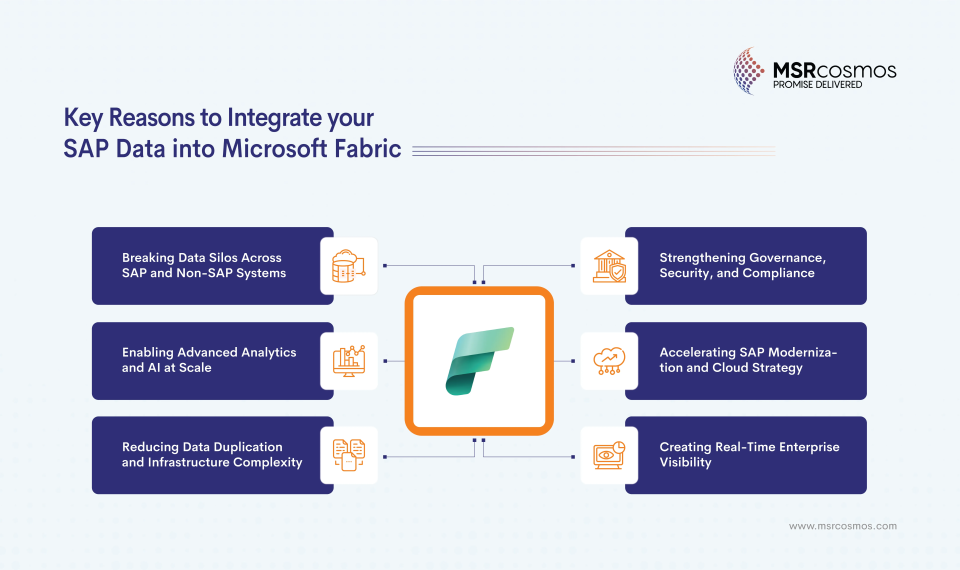
1. Breaking Data Silos Across SAP and Non-SAP Systems
Most enterprises operate complex IT ecosystems where SAP coexists with CRM platforms, external applications, data warehouses, and cloud services. When data remains fragmented across these systems, reporting becomes inconsistent and enterprise visibility suffers.
Microsoft Fabric provides a unified data layer powered by OneLake, enabling organizations to consolidate SAP and non-SAP data into a single governed environment. This eliminates disconnected analytics efforts and allows leadership teams to view enterprise performance holistically rather than in isolated segments.
A unified data strategy becomes achievable when SAP data is no longer confined to traditional system boundaries.
2. Enabling Advanced Analytics and AI at Scale
Modern enterprises are moving beyond dashboards toward predictive analytics, machine learning, and generative AI. However, advanced analytics requires scalable, high-quality, and well-governed data foundations.
Microsoft Fabric, built on Delta Lake architecture within OneLake, supports both real-time and batch processing of SAP data. Once integrated, SAP datasets can power forecasting models, anomaly detection, AI copilots, and intelligent automation use cases.
Fabric’s native integration with Power BI and AI services allows enterprises to move seamlessly from raw SAP data to actionable insight. Instead of analyzing past performance alone, organizations gain the ability to anticipate trends, optimize operations, and support data-driven decision-making at scale.
3.Reducing Data Duplication and Infrastructure Complexity
Traditional SAP integration strategies often depend on heavy replication pipelines, multiple data marts, and redundant storage environments. Over time, this increases costs and creates governance challenges.
Microsoft Fabric simplifies architecture by centralizing storage and analytics within a unified SaaS platform. With OneLake serving as a single source of truth, organizations can minimize unnecessary duplication while maintaining performance and scalability.
This streamlined architecture reduces operational overhead, improves cost transparency, and creates a more sustainable data strategy aligned with long-term cloud objectives.
4. Strengthening Governance, Security, and Compliance
As data volumes expand, governance becomes more complex. Regulatory frameworks require clear lineage, traceability, and secure access across enterprise systems.
Microsoft Fabric enhances governance by offering centralized metadata management, built-in lineage tracking, and role-based access controls across SAP and enterprise datasets. Security policies can be applied consistently across the platform, ensuring sensitive SAP data remains protected while still accessible for analytics.
By embedding governance into the core data structure, regulated organizations can ensure constant audit readiness and more robust compliance without the need for external layers
5. Accelerating SAP Modernization and Cloud Strategy
Many enterprises are already modernizing SAP landscapes through S/4HANA transitions or SAP on Azure initiatives. Integrating SAP data into Microsoft Fabric complements these strategies by extending analytics and AI capabilities without disrupting core ERP operations.
Fabric aligns naturally with Azure-based SAP environments, supporting hybrid and multi-cloud architectures while providing consistent analytics experiences across platforms. This ensures modernization efforts are not limited to infrastructure upgrades but extend into intelligent data transformation.
By connecting SAP modernization with Fabric integration, organizations build a scalable, future-ready architecture that supports innovation long after migration initiatives are complete.
6. Creating Real-Time Enterprise Visibility
In dynamic markets, leadership teams cannot rely solely on periodic reports. They require near real-time insight into financial performance, operational efficiency, and supply chain risk.
Microsoft Fabric enables real-time data ingestion and analytics on SAP datasets, allowing enterprises to monitor performance continuously. Unified analytics dashboards powered by Fabric provide executives with up-to-date, actionable insights.
This level of visibility enhances agility, strengthens risk management, and supports proactive decision-making across the organization.
Conclusion
Integrating SAP data into Microsoft Fabric is more than a technical initiative. It is a strategic move toward building a unified, AI-ready, and governed enterprise data foundation. By breaking silos, enabling advanced analytics, simplifying architecture, and strengthening compliance, organizations unlock greater value from their SAP investments. SAP evolves from a transactional system of record into a scalable intelligence asset that supports real-time decision-making and enterprise-wide visibility.
As AI adoption and cloud modernization accelerate, unified data platforms will define competitive advantage. Microsoft Fabric provides the scalable architecture required to transform SAP data into actionable insight. MSRcosmos supports enterprises in designing and implementing secure SAP-to-Fabric integration strategies aligned with Azure and AI goals, helping organizations build intelligent, future-ready data ecosystems that drive sustainable growth.